
The ‘R’ word has been mentioned more in recent weeks, which tends to attract the attention of most observant liquidators, and I have not been immune.
A word of warning, this article contains enough graphs and statistics to make Alan Kohler blush, so if such things trigger you, I apologise and will not be offended if you park your eyeballs here.
Since 2022, Australia’s corporate insolvency rate (as a proportion of total businesses) has been increasing quickly (by almost 300%).
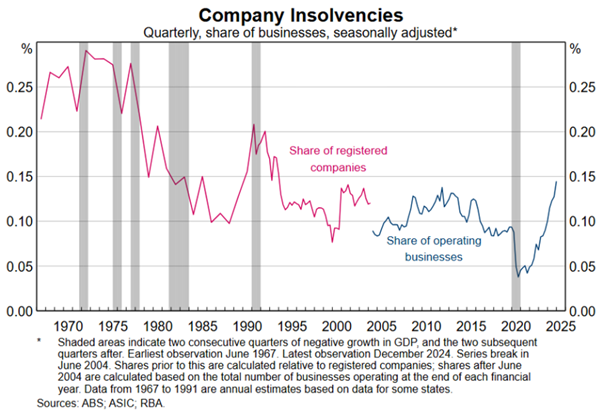
Whilst the number of external administrations in FY26 were at an all-time high, we are nowhere near the lofty highs of the ’70’s, when insolvency rates are considered as a proportion of total registered companies.
Australia has recorded relatively few technical recessions since 1970 and the historical relationship between recession and corporate insolvency rates has been anything but predictable when considered in isolation.
What could we expect from a new recession?
I have explored whether the consumer confidence index may provide greater context to the periods of recession, allowing us to better anticipate the relationship between recession and corporate insolvency rates at any given point in time.
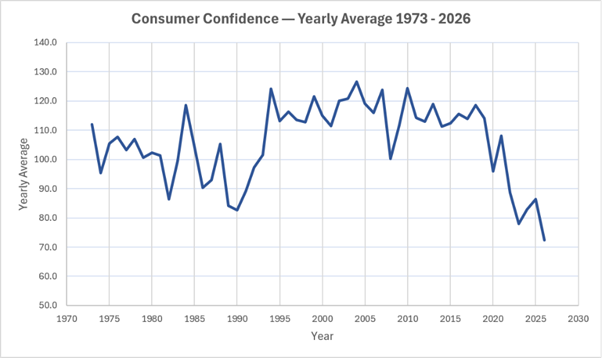
The below chart plots Australian consumer confidence since 1973.
I have overlaid the consumer confidence data above onto the corporate insolvencies / recession data, as depicted below:
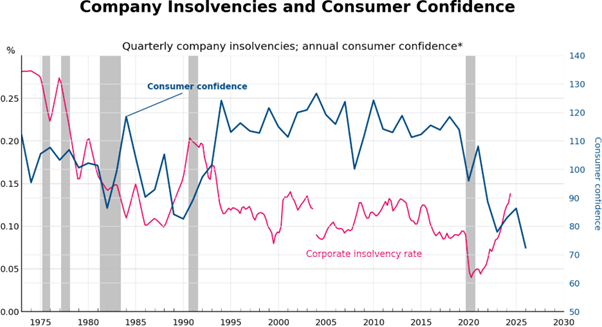
Corporate insolvency rates fell during the 1970’s recession, fell leading into the 1980’s recession before staying flat, and they rose sharply leading into the 1990’s recession. Whilst corporate insolvency rates during recessions appear to be somewhat unpredictable, when consumer confidence is added to the story it appears to provide more insight as to what corporate insolvency rates may do.
The early 1990s recession (yep, the one we had to have) provides the clearest historical example of elevated corporate insolvency rates during a recession. Furthermore, when looking at consumer confidence, this index took a nose-dive from around 1984 (my birth year, so I try not to read into that) until around 1990, seemingly culminating in the 1990/1991 recession.
The 2020 (Pandemic) technical recession produced an unusual result and should be relied on cautiously: formal insolvency activity was extremely subdued (apologies to the many liquidators still suffering from PTSD) notwithstanding the recession and consumer confidence had plunged coming into the pandemic which would have ordinarily, I expect, caused corporate insolvency rates to become elevated.
I consider the Pandemic to be an anomaly due to the extraordinary Government support, temporary restrictions on creditor enforcement and other interventions that created an artificial insolvency environment. For this reason, the Pandemic data should not be relied upon too heavily when considering the correlation between recessions and corporate insolvency rates.
It is no doubt true the elevated corporate insolvencies since the Pandemic (both numbers and rates) are to some degree making up lost ground from when insolvency was effectively paused, and by extension these elevated levels would have to be treated as somewhat artificial given their cause. However, I think we may have been placing too much weight on this ‘catch up’ argument. If we adopt the patterns of the mid-80’s and early ’90s, we can now see the elevated corporate insolvency rate is also likely in response to plummeting consumer confidence, which is at an all-time low.
In my opinion, the limited historical data supports that insolvency rates would increase meaningfully further in the event of a recession in the near future, so long as the consumer confidence index remained at its current level or declined further.
Are higher insolvency rates possible?
You may question whether the record insolvency numbers have largely cleared out the dead wood from the economy, leaving fewer distressed entities among the approximately 2.8m actively traded Australian businesses, thereby, muting the further impact a new recession may have on corporate insolvency rates.
However, when you consider that the net change of business entries and exits over the past three years (average of 2.8% increase in businesses year on year), is consistent with the three years prior to the Pandemic, and there are around 23% more actively traded business now (at 30 June 2026) compared to 30 June 2020, my view is the significant insolvency rates we have recently experienced do not appear to have caused a decoupling from the longer term trend and there is, therefore, likely sufficient dry lumber in the forest ready to ignite if a recession strikes and, importantly, consumer confidence remains at these record low levels, or deteriorates further.
Pitfalls of insolvency predictions
There are, of course, pitfalls to trying to predict what future insolvency rates will look like. The biggest one, which I perhaps should have opened with, is that my predictions on insolvency always seem to be wrong!
Additionally, history argues against predicting an impact on insolvency rates from the GDP result alone. Whilst the addition of the consumer confidence data assists, as demonstrated above, Government policy can also impact the outcome significantly.
Fundamentals remain the same
While I may have set upon this folly hoping to stumble upon an undeniable method to predict insolvency rates during a recession, the reality is for most of us it is the economic circumstance of our clients that ought to attract our greatest attention. And what is undeniable here, is that the fundamental leading indicators to determine a company’s risk of insolvency remain cash-flow shortfalls, continuing losses, ATO and superannuation arrears, and creditor enforcement.
These are things Xero or MYOB likely already know about your clients, but, sadly, I do not. Accordingly, a director needs to be willing to seek advice about the available options to avert a crisis and avoid becoming an unwilling piece of data feeding the insolvency charts.
Article by Matthew Bookless (Director) – Gold Coast